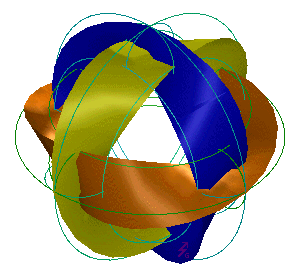
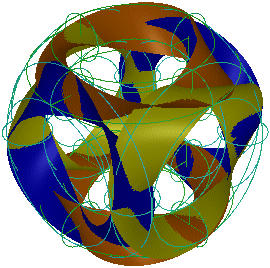
This picture shows a particle consisting of three rings. Every ring consists of two energy particles - at every three dimensional level - which are rotating around themselves. The screwing is constructed by the phase difference of each level rotation. This produces also a sucktioning effect from one side of a ring to the other - comparing a magnetic effect. The screwed behaviour causes a 'rotation' of the whole ring, what could be compared with the spin of an electron. Furthermore the structure of each ring - whether consiting of positive, negative or both energy particles - describes the behaviour of the whole particle and so the kind of the specific particle (electron, positron, neutrino, ...).
The explanation for that screwed formation is the following. As we know matter can be described by a wave. This wave starts at the center of the matter particle at a energy peak of inf.. On one side positive, on the other negative. The amplitude decreases and the wavelength increases with the distance from the center. Processing this wave all around the particle's center, the screwed formation will be generated.
The explanation for the wave at all is the infinity of dimensions of our Universe. Every point of time consumption around an energy particle's center rotates around the axis of the time dimension and this around another axis of another dimension. Therefor you get the formations I've described. One may also notice that moving the particle's wave causes a rotating movement around the center. This description of an energy particle represents a 'Mobius Strip' to every direction and dimension.
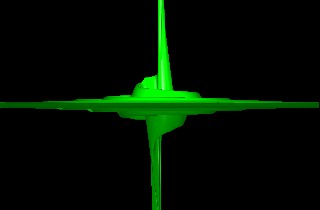
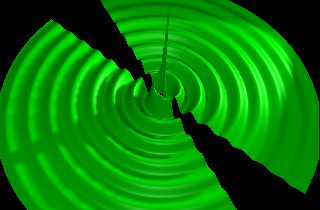
The following pictures show the time flux constellation near the split space dimension. This can be compared to the potentional energy by setting the point of reference to the infinite. As every particle is only a rotating dimensional appearence, this time flux lookout is caused by the time particles, which are also rotating in their time dimension.
Here's a Gnuplot file of the pictures below: particle.plt
(thinking...)
 Back to GRAVI's place
